James Ravilious
James Ravilious - a quiet photographer
In an era of self-referentiality a ‘quiet photograph’ (1) can have much to commend it. There is a simple and rare pleasure in looking at photographs that are unposed and un-embellished.
James Ravilious (‘JR’) documented the disappearing world of 1970’s and 1980’s north Devon, a county in England. His pictures provide a rich visual ethnographic record and all that good stuff, but they also make us want to ‘belong’ to some place. At least that’s the feeling I get when I look at his photos. We see in JR’s work a celebration of (a yearning for?) community and meaningful relationships, perhaps as a result of their absence in his early boarding school life (2). We enter his photographs perhaps with a felt but unthought sense of dislocation, for 40 years on a special sense of belonging to a place seems hard won.
JR’s photography expresses ‘mood’ and it is this that makes it compelling. JR understood, perhaps instinctively, those visual features that give rise to the invocation of moods (3), as certainly did his early mentor, Cartier-Bresson.
One cannot look at JR’s photographs without noticing his impeccable sense of timing:
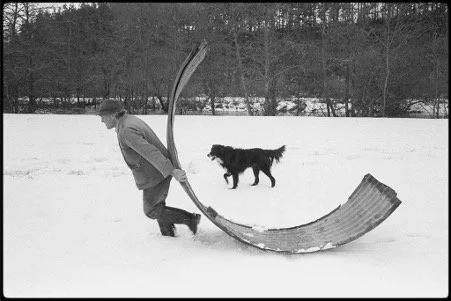
‘Alf Pugsley moving a shed in case of flood, Lower Langham, Dolton, February 1978’: Photograph by James Ravilious © Beaford Arts digitally scanned from a Beaford Archive negative.
Cartier-Bresson made much of ‘the decisive moment’ (3) and Lartigue, ‘the caught moment’. But there is more to timing than time! There is also structure. As Cartier-Bresson said,
“In a photograph, composition is the result of a simultaneous coalition, the organic coordination of elements seen by the eye. One does not add composition as though it were an afterthought superimposed on the basic subject material, since it is impossible to separate content from form. Composition must have its own inevitability about it” (my emphasis).
The ‘decisive moment’ is a taking in of the totality of situation within a structure. We are used to conceiving it as the apex of an action, as in Cartier-Bresson’s ‘puddle’ photograph, but quiet photographs can also display such characteristics. For example, in this photograph:
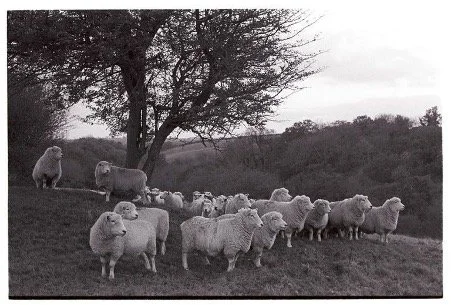
‘Flock of sheep, Ashreigney, November 1977’: Photograph by James Ravilious © Beaford Arts digitally scanned from a Beaford Archive negative.
We see sheep at close quarters all looking away from the camera. No great drama here but exquisite timing requiring patience and vision. In ‘George Ayre with hay for sheep’, we see the gestalt principles of the ‘good curve’ and ‘closure’ working together to provide the characteristics of this moment.
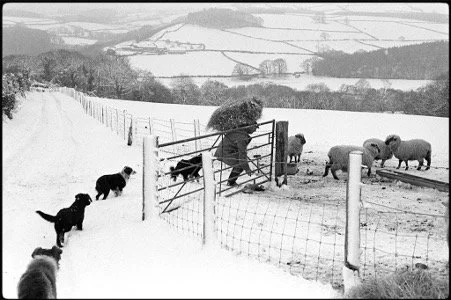
‘George Ayre with hay for sheep, Ashwell, Dolton, February 1978’: Photograph by James Ravilious © Beaford Arts digitally scanned from a Beaford Archive negative.
And in ‘Lower Gunstone’ we can imagine JR waiting ‘like an angler’ for the right elements to coalesce into the right structure:
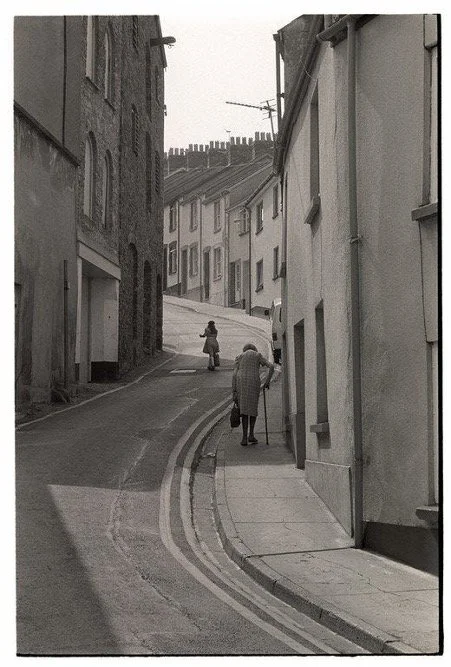
‘Lower Gunstone, Bideford, July 1983’: Photograph by James Ravilious © Beaford Arts digitally scanned from a Beaford Archive negative.
Much has been made of JR’s camera technique: his use of uncoated Leitz lenses, the creative inclusion of lens flare, the taming of deep contrast with compensatory developers all add to a signature look:
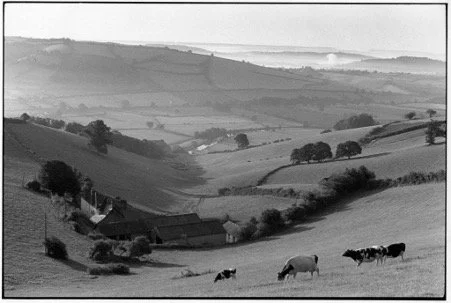
View of Pitt Farm near Cadeleigh, and the River Exe Valley, 1996
As beautiful as this signature look is (4), JR’s success is really grounded in the relationships that he built. For sure his camera technique contributed to the look of his images, but the real work that he put in was the countless hours he spent over many years in becoming accepted and therefore invisible. His mentor, Cartier-Bresson achieved this through stealth and looking inconspicuous. But Cartier-Bresson moved through a scene never to be visited again. Ravilious visited his locations many times and, in so doing, became part of the community he photographed. Sometimes the best place to hide is to be in full view, to be part of the natural order of things
A favourite photographer, Gordon Parks, once exhorted ‘Make pictures that matter!’ JR achieved this. Someone in 100 years time will look at his photographs and, like me, be moved.
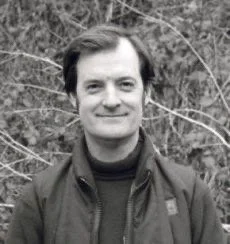
James Ravilious © Robin Ravilious; with thanks to Robin Ravilious.
I would like to thank the trustees of Beaford Arts for the free use of JR’s photographs from the Beaford Archive and in particular Olivia Riley at the Beaford Archive who was extremely helpful. The Beaford Archive holds digital scans of the 1,700 negatives which James Ravilious regarded as his finest work. It is slowly uploading 10,000 unseen (until now!) photographs by Ravilious and Deakins and are about half way through a 3 year digitisation project to make the archive more accessible.
I would like to thank Robin Ravilious, JR’s wife, for the generous support she gave me in this short article.
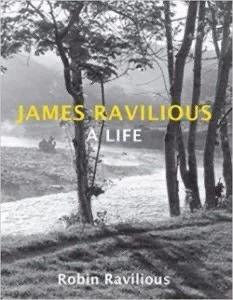
Robin has written a magnificent book portraying both James’s life before she met him and their life together afterwards: ‘James Ravilious, A Life‘, by Robin Ravilious, published Wilmington Press, an imprint of Bitter Lemon Press, 2017. It is an honest account of their lives, both ups and downs, which I enjoyed reading immensely.
As a photographer myself, I have been inspired by JR’s photographs. In this regard I have studied the photographs selected by John Hatt in the book ‘The Recent Past, James Ravilious‘, with an introduction by Robin Ravilious (published 02/11/17, Wilmington Press, an imprint of Bitter Lemon Press). This is a very thoughtful collection, beautifully reproduced.
Notes
1 The Pleasures of Good Photographs, essays by Gerry Badger; Aperture, 2010: — “The primary characteristic of the “quiet” photograph is that it should appear to be “without author or art. That is to say, transparency is its main objective. The photograph should seem to be a direct and unmediated transcription of the scene before the camera, as if taken, indeed, by the unaided camera. The quiet photographer, therefore, interferes as little as possible with his subject”.
2 See ‘James Ravilious; A Life‘ by Robin Ravilious; Bitter Lemon Press, London; 2017
3 In 1952 Cartier-Bresson published ‘Images à la Sauvette’, which approximately translates as ‘images on the run’. Cartier-Bresson cites 17th century Cardinal de Retz, who said ‘Il n’y a risen dans ce monde qui n’air un moment decisif’.
4 Of course, this scan from a print does not do justice to the tonalities and textures of the actual print
