My approach
Principles
First let me set out the principles that underpin my strategy.
The key goal is to maintain as much capacity as possible into old age. That means being ‘physically effective’ for a particular situation. It could be running for a bus, digging the garden, climbing the stairs, cutting your toe-nails, something as simple as remaining mobile. Some of these things become very difficult for old people.
Therefore, I want my training to be generalist - that is, geared towards meeting the unexpected, fit across many eventualities. That means compromising - not excelling at one activity at the expense of another.
Therefore, there will be a major functional component to my training. Cross Fit has become very popular as an exercise philosophy, but it’s a re-branding of something that has always been around. But that’s OK, I’m in favour of things being re-packaged for new generations. In my younger years we called it ‘PE’, but I grant that it has been much further developed and refined under the aegis of Greg Glassman and others.
An important part of any training approach is the understanding of what is primitive to each activity - what aspects of the musculo-skeletal-neural pathways are being exercised. That way, we learn better efficiency at becoming more effective. I want to take a scientific/bio-engineering approach. That’s not to say, however, that I see the body as purely mechanistic. I don’t. Mechanism can’t explain intention. However the relationship between the brain and the body is poorly understood and certainly depends on a web of push and pulls. A recent introduction to a scientific paper states: ‘The brain–heart connection, particularly during physical activity, plays a crucial role in health and disease management. This review examine(s) the neurophysiological mechanisms driving cardiovascular adaptations to exercise, focusing on the bidirectional relationship between the brain and heart’ (my emphasis).
It concludes: ‘Exercise enhances cerebral perfusion, reduces oxidative stress, and protects brain–heart health. It mitigates risks linked to neurodegenerative diseases, such as Alzheimer's and Parkinson's, by promoting neuroplasticity and vascular integrity’.
Although objective measures are important to tracking progress, for example - VO2 Max, Lactate Threshold, FPT, HDL to LDL ratios, Blood Pressure, Recovery time to Base - the most important thing will be how I feel.
Again, the objective measures stand in as proxy for how we subjectively feel. But we must not confuse the two.
Finally, the crucial thing about training is the fostering of the brain-body relationship, still a poorly understood phenomenon.
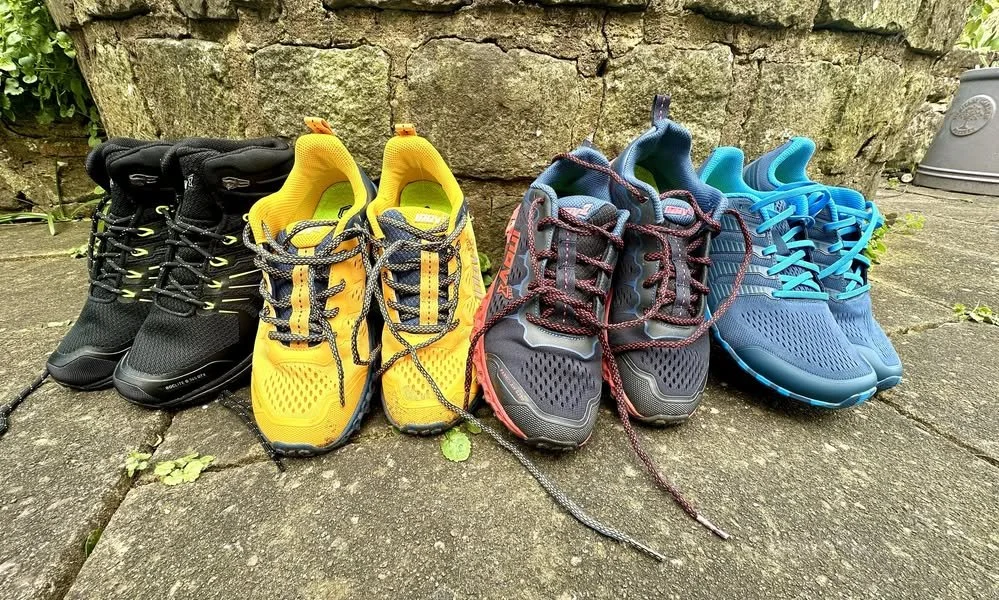
My Trail shoes - most of my running is on trails or footpaths or across fields.
Capacities
Although I want to cover all the bases of ‘fitness’, because they are interrelated, some are more important than others as one gets old. I’ll briefly describe them using a list originally created by Jim Cawley at Dynamax.
1. Cardiovascular/Respiratory Endurance
Definition: The ability of body systems to gather, process, and deliver oxygen.
Yes very important - to be covered through HIT and steady state work
2. Power
Definition: The ability of a muscular unit, or combination of muscular units, to apply maximum force in minimum time.
Crucial with older age. Power-lifting, medicine ball work outs, sprints etc.
3. Coordination
Definition: The ability to combine several distinct movement patterns into a singular distinct movement.
Yes, super important. Best tackled with compound successive movements, such as medicine ball training.
4. Flexibility
Definition: The ability to maximize the range of motion at a given joint.
Again, foundational with older age
5. Balance
Definition: The ability to control the placement of the bodies center of gravity in relation to its support base.
Super important - Trained though movements like alternate leg lunges, boxing bag, wobble board, cycling.
6. Strength
Definition: The ability of a muscular unit, or combination of muscular units, to apply force.
Important as you grow old, but probably not as important as power, which is a more dynamic feature. Of course, Power has a Strength component.
7. Speed
Definition: The ability to minimize the time cycle of a repeated movement.
Less important with age, I would say.
8. Stamina
Definition: The ability of body systems to process, deliver, store, and utilize energy.
Perhaps less important with age, but nevertheless covered through long hill walks and long sessions on the Erg Bike and runs.
9. Agility
Definition: The ability to minimise transition time from one movement pattern to another.
Not as important as co-ordination.
10. Accuracy
Definition: The ability to control movement in a given direction or at a given intensity.
Not so important as you grow old, unless one is competing in an event that requires precision, like gymnastics or dancing.
Strategy
All these dimensions are important but for maintaining capacity into old age I would emphasise the following 5: Cardio; Power; Coordination, Flexibility and Balance - THE BIG FIVE: ‘CPCFB’.
In the next post I will look at building a programme that incorporates all ten capacities but with emphasis on CPCFB.
